
 |
 |
 |
 |
 |
 |
 |
 |
On This Site |
• William Bradford |
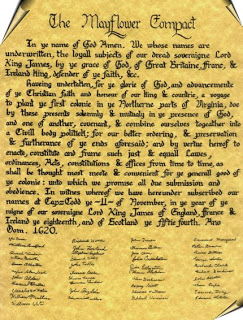
The Mayflower Compact, thought to be one of the forerunners of the Constitution, was signed on November 11, 1620, by 41 men aboard the Mayflower, the ship that had brought the Pilgrims to America.
 The ship had set sail from England with Virginia as its destination, but weather conditions forced the ship to land farther north, in what is now Provincetown Harbor, near Cape Cod. Because of this, and because they were no longer governed by the contract they had signed with the colony's investors, some aboard voiced their intention to abandon the group and set out on their own. Hearing such "mutinous speeches," as he called them, William Brewster organized the drafting of a document to describe a sort of self-government, under which the settlers would agree to live and work together for mutual survival.
The result was a framework for self-government, in which the settlers agreed to form a "body politic" that would name leaders by majority vote, in the same way that they had done in their church congregations in England and Holland.
The document itself was approved by a majority of the men aboard the ship, and 41 male passengers (including longtime Plymouth Colony Governor William Bradford) signed their names, agreeing to adhere to its outline. (More than 100 people were aboard the Mayflower, but not all were men or Pilgrims. Non-Pilgrims were referred to as "strangers.")
The signers professed their allegiance to the English King, James I. So the Mayflower Compact was not a blueprint for the Declaration of Independence. However, with its basis in the idea of a social contract associated with self-government ("just and equal Laws, Ordinances, Acts, Constitutions and Offices, from time to time, as shall be thought most meet and convenient for the General good of the Colony"), the Mayflower Compact was very much on the minds of English colonists settling in America in the years to come.
The Mayflower Compact was not referred to as such until 1793. At the time, Bradford referred to it as "an association and agreement." Subsequent historians referred to it other ways, including as a "solemn contract." But it wasn't until Alden Bradford's A Topographical Description of Duxborough, in the County of Plymouth that the term Mayflower Compact appeared.
| "In the name of God, Amen. We, whose names are underwritten, the Loyal Subjects of our dread Sovereign Lord, King James, by the Grace of God, of England, France and Ireland, King, Defender of the Faith, e&. Having undertaken for the Glory of God, and Advancement of the Christian Faith, and the Honour of our King and Country, a voyage to plant the first colony in the northern parts of Virginia; do by these presents, solemnly and mutually in the Presence of God and one of another, covenant and combine ourselves together into a civil Body Politick, for our better Ordering and Preservation, and Furtherance of the Ends aforesaid; And by Virtue hereof to enact, constitute, and frame, such just and equal Laws, Ordinances, Acts, Constitutions and Offices, from time to time, as shall be thought most meet and convenient for the General good of the Colony; unto which we promise all due submission and obedience. In Witness whereof we have hereunto subscribed our names at Cape Cod the eleventh of November, in the Reign of our Sovereign Lord, King James of England, France and Ireland, the eighteenth, and of Scotland the fifty-fourth. Anno Domini, 1620." | ||
| John Alden Isaac Allerton John Allerton John Billington William Bradford William Brewster Richard Britteridge Peter Brown John Carver James Chilton Richard Clarke Francis Cooke John Crackstone Edward Doty Francis Eaton Thomas English Moses Fletcher Edward Fuller Samuel Fuller Richard Gardinar John Goodman |
Stephen Hopkins John Howland Edward Leister Edmund Margesson Christopher Martin William Mullins Degory Priest John Rigsdale Thomas Rogers George Soule Myles Standish Edward Tilley John Tilley Thomas Tinker John Turner Richard Warren William White Thomas Williams Edward Winslow Gilbert Winslow |
|
|
Search This Site

Custom Search
|
Social Studies for Kids
copyright 2002–2026
David White