
 |
 |
 |
 |
 |
 |
 |
 |
Part 2: President for a Term
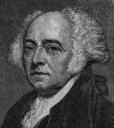 Elected
vice-president under George Washington for two terms, Adams
distinguished himself more outside the federal offices. He
and Alexander
Hamilton
saw to the beginnings of the Federalist
Party,
which, though short-lived, had a major impact on the
government and subsequent presidents. Adams was elected
president in his own right when Washington bowed out after
two terms. The rules then were simply that the two top
vote-getters got the two top offices. Thus, John Adams and
Thomas
Jefferson,
political rivals, were President and Vice-President.
Elected
vice-president under George Washington for two terms, Adams
distinguished himself more outside the federal offices. He
and Alexander
Hamilton
saw to the beginnings of the Federalist
Party,
which, though short-lived, had a major impact on the
government and subsequent presidents. Adams was elected
president in his own right when Washington bowed out after
two terms. The rules then were simply that the two top
vote-getters got the two top offices. Thus, John Adams and
Thomas
Jefferson,
political rivals, were President and Vice-President.
Adams's
presidency was beset by division at home and dissension
abroad. His own party did not support him at times,
believing, like Hamilton, that war with France was
necessary. On this issue, Adams was in the middle, with
Jefferson and his Democratic-Republicans
on the side of the French Revolutionaries on philosophical
grounds. To make matters worse,  ships
from Britain and France were seizing American ships in
international waters. Adams tried his hand at diplomacy,
having been successful in that arena in the past. But his
choice of people was not too swift here, as the negotiations
exploded into the XYZ
Affair,
which involved an attempted bribe of the French minister in
exchange for a peace treaty.
ships
from Britain and France were seizing American ships in
international waters. Adams tried his hand at diplomacy,
having been successful in that arena in the past. But his
choice of people was not too swift here, as the negotiations
exploded into the XYZ
Affair,
which involved an attempted bribe of the French minister in
exchange for a peace treaty.
Out of this affair came the Department of the Navy and its most famous early product, the USS Constitution, "Old Ironsides." But Adams was determined to keep the peace, and keep it he did with a treaty signed by the French Foreign Minister himself: Talleyrand. As the European wars continued, Adams followed Washington's lead and kept America out.
Next page > One Term and Out > Page 1, 2, 3
|
Search This Site

Custom Search
|
Social Studies for Kids
copyright 2002–2026
David White